On Memorial Day, it is worth asking whether the world’s two great powers could choose cooperation over conflict.
Memorial Day is a day for remembering fallen U.S. heroes.
We remember the men and women who gave their lives in service to this country. We remember the families who received the folded flags. We remember the empty chairs, the names etched into stone, and the price America has paid, again and again, when history becomes war.
As it so often has, to our great cost. In recent years, Memorial Day has also meant wondering who will die in future wars. Whose sons and daughters will be honored in ten years? In 20?
In 50?
So Memorial Day is exactly the right day to ask whether every future conflict we are warned about is truly inevitable.
For several years now, the conventional geopolitical wisdom has been that the United States and China are drifting toward some kind of larger confrontation. Maybe not a shooting war tomorrow. Maybe not even a direct war at all. But a colder, harder world. Rival spheres. Broken supply chains. A Pacific arms race. Taiwan as a flashpoint. Technology as a battlefield. Trade as leverage. Diplomacy as theater.
Maybe that is where things are headed.
But what if it is not?
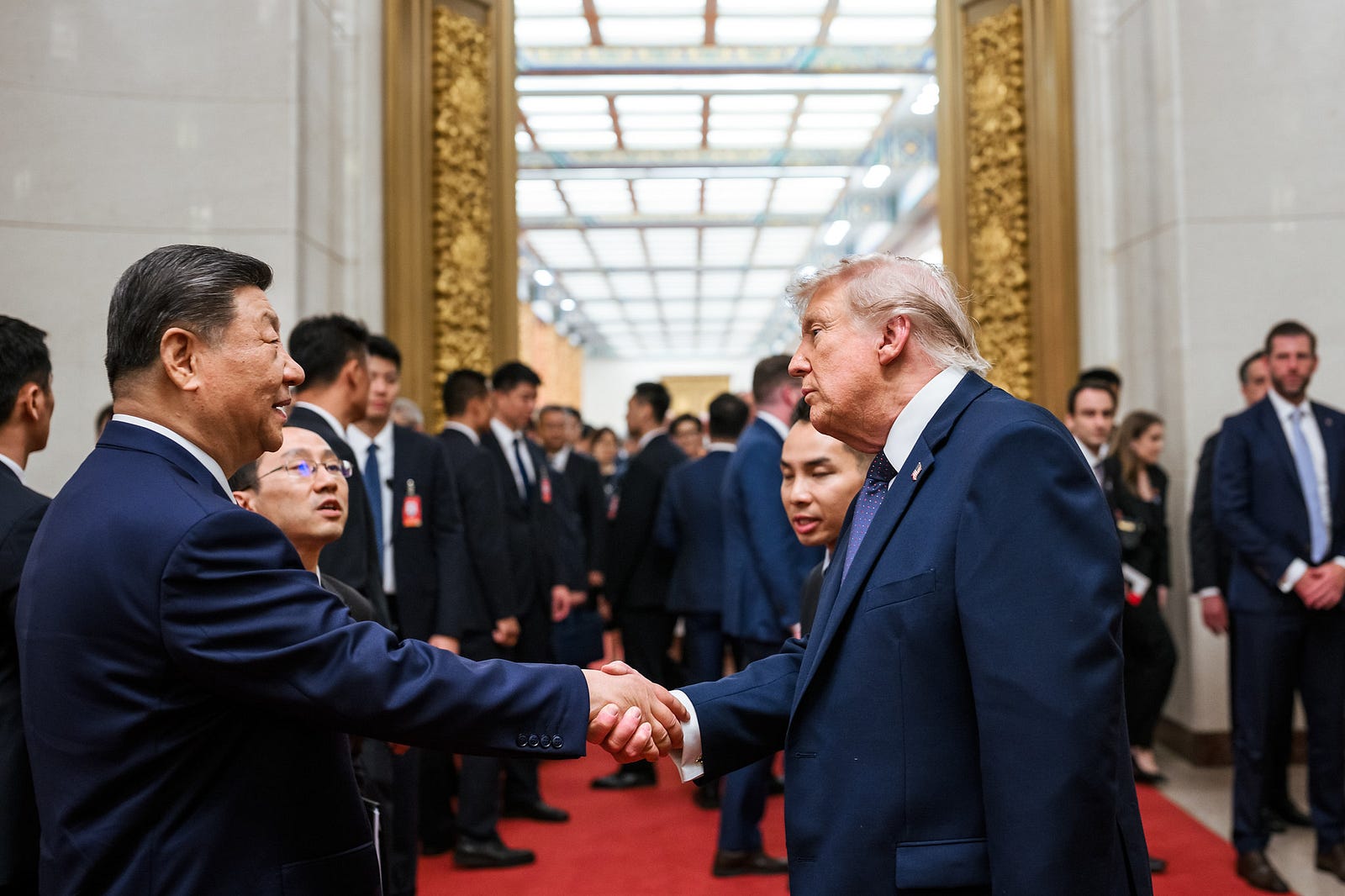
President Trump’s recent meeting with Xi Jinping seems to have changed the diplomatic atmosphere in ways that are still unfolding. The Iran negotiations suddenly look more serious. China may have pressure points with Tehran that the United States simply does not. America has forms of power China cannot match. Together, they may be able to move pieces on the board that neither country could move alone.
That is not naïveté. That is statecraft.
The United States and China are not friends in the ordinary sense. They are more like rivals. Competitors. Geopolitical frenemies with different systems, different interests, and very different visions of power. But nations do not have to be best friends to create great good and prevent catastrophe. In fact, the most important diplomacy often happens between countries that distrust each other.
Imagine what the world’s two most powerful countries could accomplish if they decided that cooperation on certain global problems was more useful than constant escalation.
They could help keep border disputes from becoming full-blown wars — Ukraine and Russia, India and Pakistan, future conflicts in Africa, the Middle East, or Asia. They could cooperate on denuclearization, not because either side suddenly trusts the other completely, but because nuclear proliferation makes the whole world more dangerous.
They could work together against drug trafficking, human trafficking, organized crime, and terrorism.
They could build a serious international framework for artificial intelligence before the technology outruns human judgment.
They could pursue renewable energy breakthroughs as an engineering problem instead of a culture-war slogan. They could help emerging nations build roads, ports, hospitals, power grids, water systems, and schools.
China has lifted an extraordinary number of people out of poverty in recent decades. India has made impressive progress too. America, at its best, has always combined strength, innovation, prosperity, and generosity. What if the next era of U.S.-China competition was not simply about dominance, but about who could help stabilize more of the world?
That would be a better kind of rivalry.
None of this requires pretending China is harmless. It is not. It does not require pretending America has always been wise. We have not. It simply requires remembering that the alternative to diplomacy is often not moral clarity.
It is the battlefield. It is another name etched onto a tombstone.
On Memorial Day, we honor fallen U.S. heroes by remembering what war costs.
Maybe we honor them, too, by asking whether the next war can still be prevented.
And if so, who can prevent it?
(Contributing writer, Brooke Bell)